eHelp-MV
Help for self-help: A modular and online-based self-help program for people with mental health problems in Mecklenburg-Western Pomerania

In connection with the COVID-19 pandemic, an increase in mental health problems has been observed in the general population, leading to a greater need for psychotherapeutic support for individuals with mental health issues and disorders. To provide rapid assistance to those experiencing mental health challenges, counteract the rise in mental health disorders, and minimize the strain on the existing psychotherapeutic and psychiatric care system, low-threshold prevention and intervention measures are urgently needed. Accordingly, our project aims to develop, implement, and scientifically evaluate a guided, four-week digital self-help intervention in order to offer it to those affected throughout Mecklenburg-Western Pomerania in the long term.
The project will include 230 patients with mental health disorders who are currently on the waiting list for outpatient psychotherapy at the Center for Psychological Psychotherapy (ZPP) of the University of Greifswald. These patients participate in two consecutive digital self-help interventions after study enrollment. Each intervention includes relieving and symptom-reducing strategies as well as practical exercises from evidence-based psychotherapy methods. Trained e-coaches and digital applications support the implementation to increase user-friendliness and effectiveness. Thirty patients form the control group and receive an intervention offer only after completing the study.
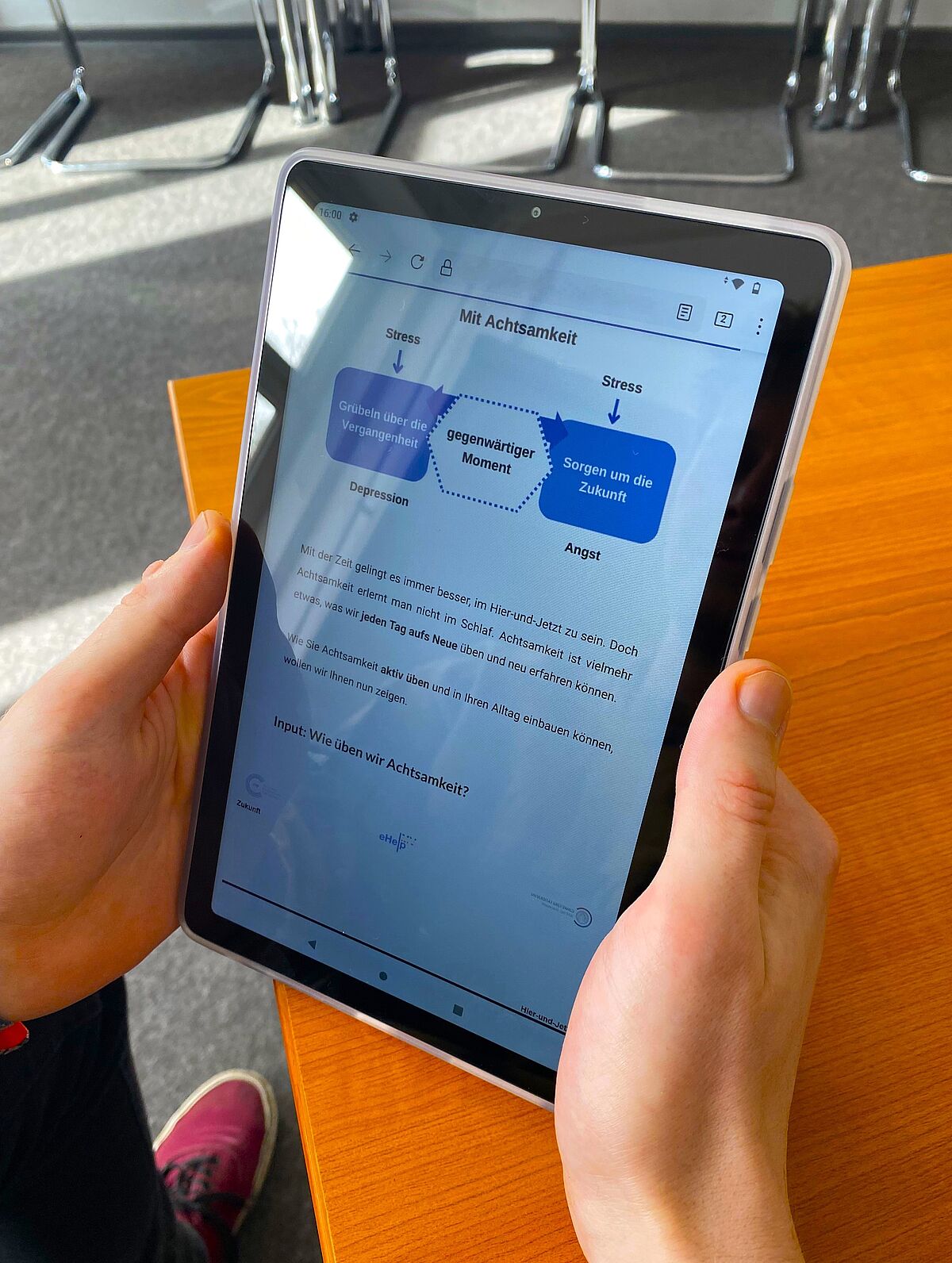
To tailor the self-help intervention to the individual needs of patients, we will use a preference condition to investigate whether the effects of self-help increase significantly when patients can choose their preferred modules themselves.
Due to the increased demand for outpatient psychotherapy at the ZPP (Center for Psychotherapy and Psychosomatics) since the beginning of the COVID-19 pandemic, completing the sample of 230 patients within a period of 18 months appears realistic.
Despite their proven cost-effectiveness, comprehensive, scientifically sound, effective, and cost-efficient self-help interventions for people with mental health problems or disorders are not yet widespread in Germany. We expect the subsequent implementation of this program in our geographically large state of Mecklenburg-Western Pomerania to reduce barriers to accessing adequate psychotherapeutic treatment options, effectively bridge waiting times, and reduce the burden of illness for those affected, their families, and society as a whole.
This project is funded by the Mecklenburg-Vorpommern State Funding Institute as part of the "Health and Prevention" program.
Magdalena Sommer, B.Sc.
Project coordinator and contact person

Stephan Bartholdy, M.Sc.
Co-Project Coordinator

Linnea Ritter
Project staff member
Contact
Institute of Psychology
Chair of Psychology and Psychotherapy
Franz-Mehring-Str. 47
17489 Greifswald
For questions about the project, please contact us at: ehelp@uni-greifswald.de.

What are the project goals?
Development, scientific evaluation, and widespread implementation of a guided self-help intervention.
Who is the target group?
Individuals experiencing mental health difficulties who require treatment but lack timely access to appropriate services.
How is access for study participants regulated?
Participants are recruited from the waiting list of the Center for Psychological Psychotherapy (ZPP) in Greifswald. Since the demand for outpatient psychotherapy has increased significantly during the COVID-19 pandemic, and the waiting time for a therapy slot has thus lengthened considerably, the self-help intervention offered is intended to provide quick and easily accessible relief, especially for those with mild to moderate impairment.
What measures are included in the project?
Development, implementation, and scientific evaluation of the intervention program with 230 patients on the waiting list of the Center for Psychological Psychotherapy Greifswald (ZPP).
How will the effectiveness be evaluated?
General and specific burdens caused by psychological symptoms are recorded using psychometric testing procedures during the course of the study and examined to investigate effectiveness.
Self-Help Interventions
Internet-based self-help interventions offer a helpful and cost-effective solution for low-threshold support services for mental health issues. These interventions provide expert-prepared content, based on techniques and strategies from evidence-based psychotherapy, via online portals. This content includes basic information (psychoeducation) and instructions for self-administered exercises, presented and guided either in text form or through multimedia content (e.g., video or audio recordings). The effectiveness of self-help interventions for mental health problems and disorders is widely considered established (e.g., Andersson & Titov, 2014; Cipriani, 2020; Weisel et al., 2018). While the programs can generally be carried out without third-party assistance, guided self-help is recommended for more severe impairments. This involves supplementary contact with an e-coach (usually a trained psychologist or psychotherapist) via email, telephone, or video chat, who supports the implementation of the techniques. This reduces the likelihood of premature termination of the interventions (Karyotaki et al., 2021). The integration of self-help interventions into public health care has been widely promoted in Commonwealth countries, particularly in the UK. Within a tiered system, the National Health Service covers the costs of such interventions for patients with low to moderate distress, while severely distressed patients receive accelerated access to intensive treatment options such as outpatient psychotherapy. Comprehensive, scientifically sound, effective, and cost-efficient guided self-help interventions for people with mental health problems or disorders are not yet widespread in Germany. Especially in the rural state of Mecklenburg-Western Pomerania, such services can significantly reduce barriers to accessing adequate psychotherapeutic treatment, effectively bridge waiting times, and, through their efficacy, also reduce the burden of illness (Komariah et al., 2022). To increase the overall efficiency of such services, future offerings must be tailored to the specific needs of those affected through an individualized approach.
Project Objectives
The objectives of the planned project are the development, scientific evaluation, and subsequent widespread implementation of a guided digital self-help intervention to support individuals experiencing mental health difficulties who require treatment but, due to limited capacity, cannot access appropriate treatment services in a timely manner after being identified as needing it. Given the increasing number of crises, the project has gained particular relevance, as the need for psychotherapeutic care continues to rise.
In a press release from the German Psychological Society (DGPs), initiated by our chair, it is stated that patients in need of treatment require timely therapy tailored to their current crises, while at the same time the existing psychotherapeutic and psychiatric care systems, including psychosocial services, must not be overburdened. One of the health policy measures called for is the development and funding of low-threshold, accessible, and short-term intervention and prevention programs for people with mental disorders or problems, programs that are tailored to the specific needs of those affected. Through this project, we aim to offer such a digital intervention and prevention program, initially to patients on the waiting list of the Center for Psychological Services (ZPP) in Greifswald, and, following successful evaluation, subsequently to people experiencing mental health difficulties in Mecklenburg-Western Pomerania.
The proposed digital self-help program is initially integrated into the personnel and organizational structures of the ZPP at the University of Greifswald. This ensures outpatient crisis intervention or acute treatment in crisis situations. Furthermore, student assistants from the University of Greifswald, after training and under close supervision by psychological psychotherapists, will be deployed as e-coaches.
Following successful implementation and evaluation at our institution with 230 patients seeking help, the intervention program will be made available throughout Mecklenburg-Western Pomerania to all patients (e.g., patients on waiting lists at other institutions and/or referring to private practitioners) and also as a preventative measure for those experiencing subclinical distress.The project aims to identify individuals at high risk for mental health disorders (e.g., individuals experiencing stress and high risk factors, see Brakemeier et al., 2020).
The overarching goals of eHelp-MV are therefore to provide rapid assistance to individuals experiencing mental health disorders through a low-threshold, digital self-help intervention (1), to counteract the increase in mental health disorders, and (3) to minimize the strain on the existing psychotherapeutic and psychiatric care system.
We expect that the implementation of the digital self-help intervention will lead to a greater reduction in psychological distress for participating patients on the waiting list of the Greifswald Center for Psychotherapy (ZPP) than for patients who do not receive a specific intervention during their waiting time. Based on the proven effectiveness of digital treatment options (Brakemeier et al., 2020), we further assume that this self-help intervention will provide such comprehensive relief to a significant proportion of patients that they will no longer require outpatient psychotherapy. Finally, we expect that for patients who still require outpatient psychotherapy after the self-help intervention, the subsequent psychotherapy will be shorter and more effective due to the partial goals already achieved, compared to patients who previously went through the waiting period without participating in self-help interventions. Follow-up surveys will provide insights into this long-term course.
The study will be conducted using a two-stage randomized patient preference trial design (Chen & Wang, 2023; Rücker, 1989; Turner et al., 2014; Wang et al., 2022), which combines the gold standard of a randomized controlled trial with a preference condition in which participants can make an informed decision about their assigned self-help intervention. A positive influence of patient preference on the effectiveness, adherence, and acceptance of the intervention is assumed. The design also offers the potential for improved external validity and a reduced dropout rate in the preferred group. The study aims to predict moderating patient characteristics that promote response to one of the self-help interventions. Quantitative evaluation will be conducted longitudinally using repeated measurements at four time points, four weeks apart, and a follow-up survey after three months. Statistical analysis of intervention effectiveness will be performed through pre-post comparisons.
References
Andersson, G., & Titov, N. (2014). Advantages and limitations of Internet-based interventions for common mental disorders. World Psychiatry: Official Journal of the World Psychiatric Association (WPA), 13(1), 4–11. https://doi.org/10.1002/wps.20083
Brakemeier, E. L., Wirkner, J., Knaevelsrud, C., Wurm, S., Christiansen, H., Lueken, U., & Schneider, S. (2020). Die COVID-19-Pandemie als Herausforderung für die psychische Gesundheit. Zeitschrift für Klinische Psychologie und Psychotherapie. Advance online publication. https://doi.org/10.1026/1616-3443/a000574
Chen, S., & Wang, W. (2023). A scoping review on two-stage randomized preference trial in the field of mental health and addiction. BMC Psychiatry, 23(1), 192. https://doi.org/10.1186/s12888-023-04676-1
Cipriani, A. (2019). Effectiveness and Acceptability of Cognitive Behavior Therapy Delivery Formats in Adults With Depression A Network Meta-analysis. verfügbar unter https://oxfordhealth-nhs.archive.knowledgearc.net/handle/123456789/212.
Karyotaki, E., Efthimiou, O., Miguel, C., Bermpohl, F., Furukawa, T. A., Cuijpers, P., Individual Patient Data Meta-Analyses for Depression (IPDMA-DE) Collaboration, Riper, H., Patel, V., Mira, A., Gemmil, A. W., Yeung, A. S., Lange, A., Williams, A. D., Mackinnon, A., Geraedts, A., van Straten, A., Meyer, B., Björkelund, C., Knaevelsrud, C., … Forsell, Y. (2021). Internet-Based Cognitive Behavioral Therapy for Depression: A Systematic Review and Individual Patient Data Network Meta-analysis. JAMA Psychiatry. Advance online publication. https://doi.org/10.1001/jamapsychiatry.2020.4364.
Komariah, M., Amirah, S., Faisal, E. G., Prayogo, S. A., Maulana, S., Platini, H., Suryani, S., Yosep, I., & Arifin, H. (2022). Efficacy of Internet-Based Cognitive Behavioral Therapy for Depression and Anxiety among Global Population during the COVID-19 Pandemic: A Systematic Review and Meta-Analysis of a Randomized Controlled Trial Study. Healthcare, 10(7), 1224. https://doi.org/10.3390/healthcare10071224
Rücker, G. (1989). A two-stage trial design for testing treatment, self-selection and treatmen preference effects. Statistics in Medicine, 8, 477–485.
Turner, R. M., Walter, S. D., Macaskill, P., McCaffery, K. J., & Irwig, L. (2014). Sample Size and Power When Designing a Randomized Trial for the Estimation of Treatment, Selection, and Preference Effects. Medical Decision Making, 34(6), 711–719. https://doi.org/10.1177/0272989X14525264
Wang, Y., Li, F., Blaha, O., Meng, C., & Esserman, D. (2022). Design and analysis of partially randomized preference trials with propensity score stratification. Statistical Methods in Medical Research, 31(8), 1515–1537. https://doi.org/10.1177/09622802221095673
Weisel, K. K., Lehr, D., Heber, E., Zarski, A.-C., Berking, M., Riper, H., & Ebert, D. D. (2018). Severely Burdened Individuals Do Not Need to Be Excluded From Internet-Based and Mobile-Based Stress Management: Effect Modifiers of Treatment Outcomes From Three Randomized Controlled Trials. Journal of Medical Internet Research, 20(6), e211. https://doi.org/10.2196/jmir.9387