The research programme of the (professorial) chair
Research on mechanism-based personalised psychotherapy
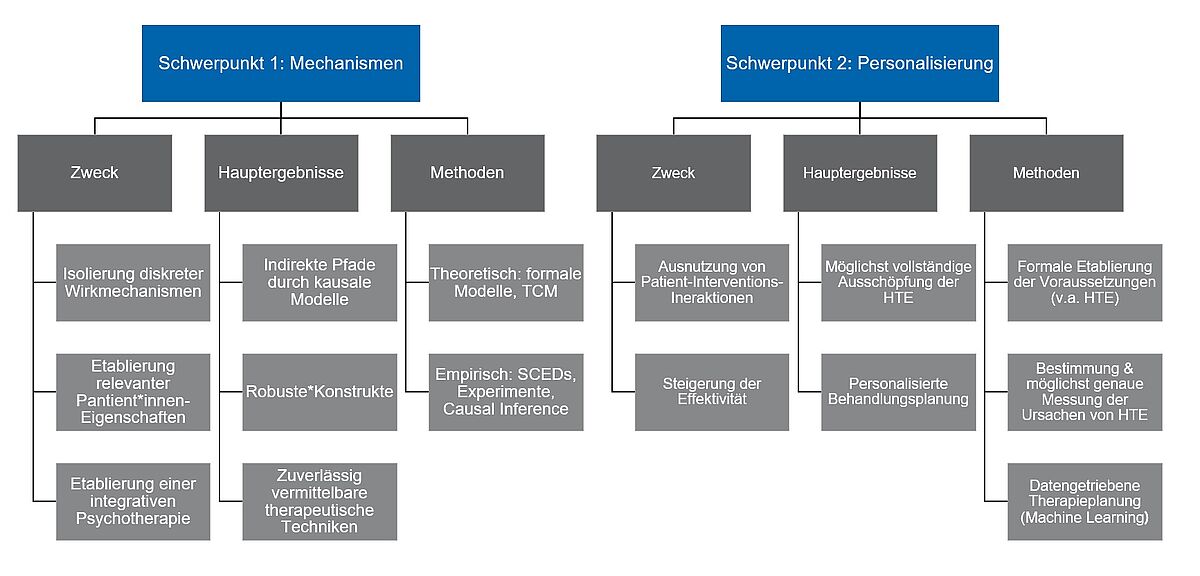
In recent decades, the focus of psychotherapy research has been on randomised controlled studies and meta-analyses to investigate the effectiveness of specific psychotherapy procedures and methods. While this key field of research has led to the successful establishment of psychotherapy in the healthcare system, other paradigms have impaired the further development of psychotherapy and obscured problems. For example, despite the proven effectiveness of psychotherapy for mental disorders, individual response rates to evidence-based psychotherapies vary widely, with around 1/3 of patients failing to respond, relapsing or dropping out of treatment prematurely. There is also a lack of robust data on predictors of response or mediators of change, meaning that the mechanisms of action of psychotherapy are largely unclear. In order to optimise psychotherapies and at the same time better understand mechanisms of action, the adjustment of psychological interventions to patient-specific characteristics is considered a promising challenge, which is also referred to as Precision Mental Health, personalised psychotherapy or Tailoring Treatments.
Through personalised psychotherapy (research), we are pursuing the goal of guaranteeing the best possible psychologist treatment for each patient. In this context, we conduct studies that are oriented towards the individual patient, investigate the central mechanisms of action, examine not only the positive effects but also the negative effects, generate translationally large data sets that are also evaluated using idiographic analyses, and reduce the gap between research and practice, thus contributing to the paradigm of practice-based research that is currently rightly moving to the centre of research. practice-based research to the paradigm of practice-based research that is currently taking centre stage. In this context, the support of practice-based research networks seems particularly desirable to us.
The centrepiece of our Greifswald research at the ZPP is the "Greifswald Psychotherapy Navigator System (GPNS)", which is intended to provide our psychologists with concrete and, above all, evidence-based recommendations for the selection and adjustment of their psychotherapeutic approach.
(Kopie 4)